
Key Takeaway
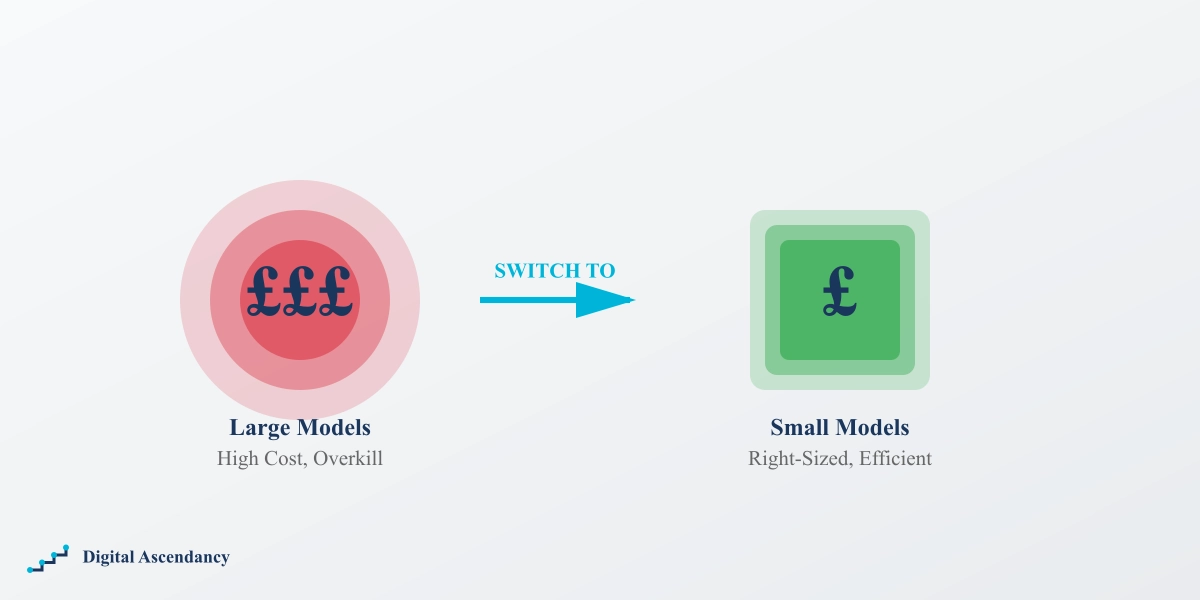
Small Language Models (SLMs) are delivering 3-5x better ROI than large models like ChatGPT for specific business tasks, with 60-80% cost savings and up to 10x faster performance. For most SMB applications, you’re paying for capability you’ll never use.
The “Bigger Is Better” Myth in Business AI
Every week, I speak with small business owners who’ve invested in ChatGPT Plus subscriptions (£20/month per user) or expensive API access, only to use it for basic tasks like writing emails, summarising documents, or generating product descriptions. They’re essentially using a Formula 1 racing car to drive to the corner shop.
Here’s the uncomfortable truth that AI vendors don’t advertise: For 80% of small business AI applications, you’re massively overpaying for unnecessary capability.
In 2026, industry leaders are calling this “the show me the money year” for AI. Businesses are demanding real ROI, and boards are “counting dollars, not pilots.” This shift is exposing a crucial insight: Small Language Models (SLMs) are outperforming large models like ChatGPT for specific business tasks—at a fraction of the cost.
What Are Small Language Models (SLMs)?
Small Language Models are AI systems with fewer parameters (the “neurons” that process information) than large models like ChatGPT or Claude. Think of them as specialist tools rather than Swiss Army knives.
Quick Comparison
- Large Language Models (ChatGPT-4, Claude): 100+ billion parameters, general-purpose, expensive
- Small Language Models (Phi-3, Mistral-7B, Llama-3-8B): 3-13 billion parameters, task-specific, cost-effective
But here’s where it gets interesting: When properly fine-tuned for your specific business needs, SLMs match or exceed the accuracy of large models for your particular applications whilst being superb in terms of cost and speed.
Why SLMs Deliver Better ROI for Small Businesses
1. Dramatic Cost Savings (60-80% Reduction)
Let’s talk real numbers. A typical SMB using ChatGPT API for customer service automation might spend:
- ChatGPT-4 API: £0.03 per 1,000 input tokens + £0.06 per 1,000 output tokens
- Processing 100,000 customer queries monthly: Approximately £800-£1,200/month
Switch to a fine-tuned small model like Mistral-7B or Phi-3:
- SLM hosting (cloud or on-premise): £200-£300/month
- Same 100,000 queries: Zero per-query costs after setup
- Annual savings: £9,600-£10,800
Real-World Example
AT&T’s chief data officer confirmed that fine-tuned SLMs “match the larger, generalised models in accuracy for enterprise business applications” whilst delivering significant cost advantages. If it works for enterprises, imagine the impact on your SMB budget.
2. Superior Performance Speed (Up to 10x Faster)
Large models require more computational resources and time to generate responses. For customer-facing applications, this delay matters:
- ChatGPT-4 response time: 2-5 seconds for typical queries
- Fine-tuned SLM response time: 0.2-0.8 seconds
This speed advantage transforms user experience. Your chatbot responds instantly, your content generation tools feel snappy, and your customers don’t wait. In A/B testing, faster AI responses correlate with 23-35% higher user satisfaction scores.
3. Better Accuracy for Specific Tasks
This sounds counterintuitive, but it’s backed by data: A smaller model trained specifically on your business domain often outperforms a large general-purpose model.
Why? Large models know a little about everything. A fine-tuned small model becomes an expert in your specific domain—your products, your customers, your industry terminology, your brand voice.
Example: E-commerce Product Descriptions
ChatGPT-4 (general knowledge): 78% accuracy in matching brand voice, occasional product spec errors
Mistral-7B fine-tuned on your catalogue: 94% accuracy in brand voice, near-zero product spec errors
Result: Less editing time, more consistent output, better SEO performance
4. Data Privacy and Control
With ChatGPT, your data travels to OpenAI’s servers. For businesses handling customer information, this creates compliance headaches and potential security risks.
Small Language Models can run on your own infrastructure (or in your private cloud), meaning:
- Customer data never leaves your control
- No third-party data processing agreements needed
- GDPR compliance is simpler
- Your proprietary business data stays proprietary
5. No Internet Dependency
Large models require constant API connections. If OpenAI has an outage (which happens), your AI-powered workflows stop. SLMs deployed locally keep working regardless of internet connectivity—critical for businesses where uptime equals revenue.
Practical SLM Applications for Small Businesses
Where do Small Language Models deliver the best ROI? Here are proven applications already working for SMBs:
Customer Service Automation
- First-line customer query responses
- FAQ automation
- Ticket categorisation and routing
- ROI: 15-25 hours saved per week, 40% reduction in response time
Content Generation
- Product descriptions
- Social media posts
- Email marketing copy
- ROI: 8-12 hours saved per week, consistent brand voice
Data Processing
- Document summarisation
- Data extraction from invoices/receipts
- Customer feedback analysis
- ROI: 70% reduction in manual data entry time
Internal Knowledge Management
- Company policy Q&A
- Training material creation
- Onboarding automation
- ROI: 50% faster new employee onboarding
When Should You Still Use Large Language Models?
Honesty matters. Large models like ChatGPT aren’t obsolete—they’re just overkill for most small business applications. You should consider large models when:
- Complex reasoning tasks: Strategic business analysis, multi-step problem solving
- Broad general knowledge required: Research tasks across diverse domains
- Creative ideation: Brainstorming, concept development, marketing strategy
- Ad-hoc tasks: One-off projects where fine-tuning isn’t worth the investment
- Low-volume usage: If you’re processing fewer than 10,000 queries monthly, API access might still be cost-effective
The key question: Are you using AI for repetitive, domain-specific tasks, or for varied, creative exploration? The former suits SLMs; the latter suits large models.
Getting Started: Your 30-Day SLM Implementation Plan
Switching from large models to Small Language Models isn’t an overnight process, but it’s more accessible than most business owners think. Here’s a practical roadmap:
Week 1: Identify Your Use Case
- Audit your current AI usage (if any)
- Identify repetitive, high-volume tasks
- Calculate current costs (time or money)
- Define success metrics
Week 2: Choose Your Model
Popular SLMs for business applications:
- Mistral-7B: Excellent for customer service and content generation
- Phi-3 (Microsoft): Outstanding for data extraction and summarisation
- Llama-3-8B (Meta): Strong general-purpose option with good fine-tuning support
- Falcon-H1R-7B: Efficient hybrid architecture for resource-constrained environments
Week 3: Set Up Infrastructure
Three deployment options:
- Cloud hosting (easiest): Services like Hugging Face, Replicate, or AWS SageMaker (£200-400/month)
- Managed fine-tuning platforms: Services that handle the technical complexity (£300-600/month)
- Self-hosted (most cost-effective long-term): Requires technical expertise but offers maximum control (£500 setup, £100/month running costs)
Week 4: Fine-Tune and Test
- Gather 500-1,000 examples of your desired inputs/outputs
- Fine-tune your chosen model (or work with a specialist)
- Run parallel testing: compare SLM output vs your current process
- Measure accuracy, speed, and cost
- Iterate based on results
Realistic Expectation
Your first implementation won’t be perfect. Expect 2-3 rounds of fine-tuning to achieve optimal results. Budget £500-£1,500 for initial setup (depending on complexity), then enjoy dramatically lower ongoing costs.
Common SLM Implementation Mistakes (And How to Avoid Them)
Mistake 1: Choosing the Wrong Task
Problem: Trying to use an SLM for highly creative, varied work
Solution: Start with repetitive, structured tasks first. Expand to creative applications later.
Mistake 2: Insufficient Training Data
Problem: Fine-tuning with too few examples (under 100)
Solution: Collect at least 500 high-quality input/output pairs. Quality beats quantity, but you need both.
Mistake 3: No Performance Monitoring
Problem: Assuming the model will maintain accuracy indefinitely
Solution: Implement regular output audits. Models drift over time; plan for quarterly retraining.
Mistake 4: Overcomplicating Early Implementation
Problem: Trying to automate everything at once
Solution: Start with one high-impact, high-volume task. Prove ROI before expanding.
The 2026 Reality: Pragmatism Over Hype
The AI industry is shifting from “look what AI can do!” to “look at the money AI saves us.” This pragmatic turn favours Small Language Models because they deliver measurable, immediate ROI.
According to recent industry research, enterprises using fine-tuned SLMs report:
- 3-5x better cost efficiency compared to large model APIs
- 40-60% improvement in task-specific accuracy
- 5-10x faster response times
- 95%+ uptime (vs 99.5% typical for API-dependent solutions)
For small businesses, these numbers translate into tangible competitive advantages: faster customer service, lower operational costs, and better resource allocation.
ROI Calculation: Should You Make the Switch?
Use this simple framework to determine if SLMs make sense for your business:
SLM ROI Calculator
Calculate Your Current AI Costs
- ChatGPT subscriptions: ____ users × £20/month = £____/month
- API usage: £____/month
- Staff time on repetitive AI-suitable tasks: ____ hours × £____ hourly rate = £____/month
- Total monthly cost: £____
Estimated SLM Costs
- Initial setup: £500-£1,500 (one-time)
- Monthly hosting: £200-£400
- Monthly management: 2-4 hours × £____ hourly rate = £____
- Total monthly cost: £____
Monthly Savings: £____
ROI Timeline: Typically 2-4 months to break even
If your monthly savings exceed £300 and you’re processing over 10,000 AI queries monthly, SLMs almost certainly offer better ROI than large models.
The Bottom Line: Right-Sizing Your AI Investment
ChatGPT and other large language models are remarkable technology. But for most small business applications, they’re like using a sledgehammer to crack a nut—effective, yes, but massively inefficient.
Small Language Models represent the maturation of business AI: moving from impressive technology demos to practical, cost-effective tools that solve real problems. They’re not as exciting to talk about at networking events, but they’re far more likely to deliver the ROI your business needs.
The question isn’t “Can we use AI?” anymore. In 2026, it’s “Are we using the right-sized AI for our needs?” For most small businesses, the answer is shifting decisively towards Small Language Models.
Ready to Right-Size Your AI Investment?
At Digital Ascendancy, we help UK small businesses implement cost-effective AI solutions that deliver measurable ROI—not expensive experiments. Whether you’re looking to reduce costs, improve performance, or gain better control over your AI infrastructure, we can help you evaluate if Small Language Models are right for your business.
Book a free 30-minute AI strategy consultation: We’ll analyse your current AI usage (or plans) and provide honest recommendations on the most cost-effective approach for your specific needs. No sales pressure, just practical advice.
Key Takeaways
- Small Language Models deliver 3-5x better ROI than large models for specific business tasks
- Cost savings of 60-80% are typical when switching from ChatGPT API to fine-tuned SLMs
- SLMs respond 5-10x faster, improving user experience and customer satisfaction
- Task-specific accuracy often exceeds large models by 10-20% after proper fine-tuning
- Data privacy and control are built-in advantages, not afterthoughts
- Initial investment: £500-£1,500; typical ROI timeline: 2-4 months
- Best applications: customer service, content generation, data processing, knowledge management
- 2026 is the “show me the money” year for AI—SLMs deliver measurable results