
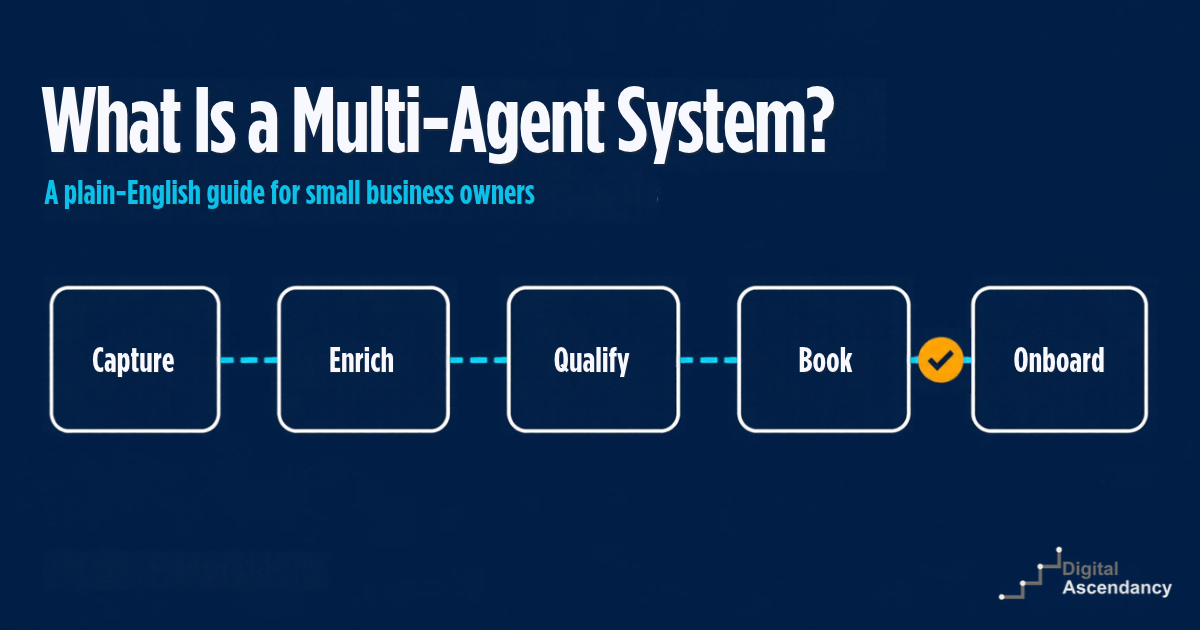
Think about what happens when a new enquiry lands in your inbox. Someone reads it and checks who sent it, perhaps looking up their website. Then a decision has to be made about whether it is worth a call. After that, a time needs finding in the diary, a confirmation needs sending and the CRM needs updating. In a small business, that “someone” is usually you, and it usually happens at the end of a long day.
Look closely and you will notice that this is not one job. It is five or six separate jobs, handed from one step to the next. That simple observation sits behind one of the most practical developments in business AI right now: the multi-agent system.
I have been listening to Austin Chen’s Artificial Intelligence for Leaders & Professionals, and one chapter walks through a lead generation pipeline built from a chain of specialised AI agents, each handling a single stage before passing the work on. It is one of the clearest ways I have come across of explaining an idea that usually gets buried in jargon. So this guide unpacks it for small business owners: what a multi-agent system is, how the agents work together, and, just as importantly, how to tell whether your business actually needs one.
Key takeaways
- A multi-agent system is a team of AI agents, each doing one specialised task and passing its work to the next.
- Specialised agents are easier to test, fix and trust than one agent trying to do everything.
- For most small businesses, a simple “relay race” pipeline is the best place to start.
- Your enquiry process is a natural first candidate: capture, enrich, qualify, book, onboard.
- Not every business needs one. If your process is not written down yet, start there.
Free live demo: Thursday 22 October, 10am
See an AI assistant answer real enquiries in a 30-minute Zoom session. No jargon, no hard sell, and you can ask questions.
First, a quick recap: what is an AI agent?
A chatbot answers questions. An AI agent completes a task. Where a chatbot tells a customer your opening hours, an agent can check your calendar, book the appointment, send the confirmation and log it in your CRM, following the same rules you would apply yourself.
If you would like the longer version, our page on AI agent development services explains the difference in more detail. For this guide, the important point is that an agent does something, rather than just saying something.
What is a multi-agent system?
A multi-agent system is a group of AI agents that each handle one specialised task and pass their work to each other to complete a larger process. Instead of one AI trying to do everything, you have a small team, with each member focused on the part it does best.
The easiest way to picture it is a restaurant kitchen. The head chef does not cook every dish personally. One section handles sauces, another handles pastry, someone else plates up. Each station focuses on its own job, and before anything leaves the kitchen it passes a final check at “the pass”. As a result, the food comes out faster and more consistently than it would from one exhausted cook trying to do it all.
A multi-agent system works the same way. Each agent is a station. And, as we will see, the most important part of a good system is your version of the pass: the point where a human checks the work before it reaches a customer.
Why not just use one big agent?
It is a fair question. After all, if AI is so capable, why not build one agent that handles the whole process? There are five good reasons to split the work up.
- Focus means fewer mistakes. An agent with one narrow job makes fewer errors than one juggling ten.
- Easier to test. You can check each agent on its own, for example whether it scores leads the way you would.
- Easier to fix. When something goes wrong, you can see exactly which link caused it.
- Easier to change. If your booking process changes, you only update the booking agent.
- A clear audit trail. Each handover leaves a record of what was decided, and why.
None of this is new thinking. In fact, it is the same reason businesses divide work into roles. AI simply lets a small business apply that principle without hiring a team.
New to this? Read AI Chatbots vs AI Agents first, or see why it pays to start with one problem.
Three ways AI agents work together
Not every multi-agent system is arranged the same way. There are three common patterns, and it helps to know which is which.
1. Sequential: the relay race
Agents work in a fixed order, and each one hands its finished work to the next. This suits predictable processes that follow the same steps every time, such as handling enquiries, onboarding new customers or chasing invoices. It is the pattern described in the book’s lead generation example, and the one this guide focuses on.
2. Parallel: working side by side
Several agents work on different parts of a task at the same time, and their results are combined at the end. For example, one agent might review a company’s website while another checks its Companies House record, with both findings merged into a single summary.
3. Supervisor: a manager and a team
One coordinating agent decides which specialist to call on, depending on the situation. This is the most flexible pattern, but also the hardest to predict and test.
In short, for most small businesses, sequential is the right place to start. It is the easiest to understand, the easiest to test, and the easiest to trust, because you always know what happens next.
A worked example: the Enquiry-to-Booking pipeline
The book’s example begins with a prospecting agent that goes out and finds potential leads. For UK small businesses, I would suggest starting somewhere different. Automated cold prospecting brings real data protection and marketing rules into play, and most businesses get more value from handling the enquiries they already receive properly. So here is an inbound version, built around what happens after someone gets in touch.
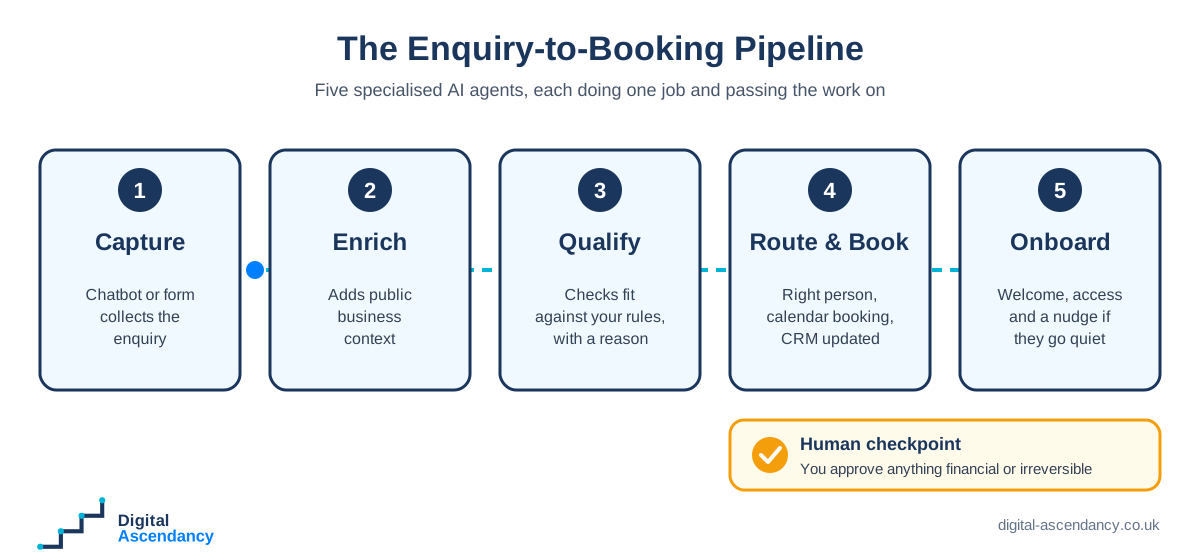
Stage 1: The capture agent
A chatbot or smart contact form collects the essentials: name, contact details and what the person needs. This is the job our Never Miss an Enquiry chatbot already does, around the clock, so no enquiry goes unanswered at 11pm on a Sunday.
Stage 2: The enrichment agent
This agent adds useful context from public business information, such as the enquirer’s company website, Companies House record, sector and location. It should only look up what is relevant to the enquiry and lawful to use. Business context, yes. Personal social media profiles, no.
Stage 3: The qualification agent
Next, the enquiry is checked against your rules. Is it a service you offer? Is it in an area you cover? Does the budget or timescale fit? A good qualification agent does not just give a score. It gives a short reason, so you can see why it reached its decision and correct it if you disagree.
Stage 4: The routing and booking agent
Qualified enquiries are sent to the right person or service line, offered available times from the calendar, booked in, and logged in the CRM. In a larger company, “the right person” is a salesperson. In many small businesses, it is simply you, and the agent’s job is to protect your diary from enquiries that are not a fit.
Stage 5: The onboarding agent
Once someone says yes or pays, this agent sends the welcome email, provides access or documents, and gives them a gentle nudge if they go quiet. The first impression stays consistent, however busy your week is.
Where does the human fit in?
Anything involving money, or anything that cannot easily be undone, should pass through a person first. That includes quotes, invoices, refunds and cancellations. You might also choose to review borderline leads that the qualification agent is unsure about. The agents draft and prepare. You approve. As you see how the system performs, you can widen what it is trusted to do on its own.
What each agent passes on
| Agent | Receives | Passes on |
|---|---|---|
| Capture | A new enquiry | Contact details and what they need |
| Enrichment | Contact details | A short business profile |
| Qualification | Enquiry plus profile | A decision with a reason |
| Routing and booking | A qualified lead | A booked meeting and CRM record |
| Onboarding | A new customer | Welcome, access and follow-up |
You don’t need a multi-agent system to get started
One well-built AI agent can chase every lead and follow-up for you. Start there, prove it works, then add the next one.
Being honest: when you do not need a multi-agent system
Multi-agent systems are genuinely useful, but they are not for everyone. You probably do not need one yet if:
- You only receive a handful of enquiries a month. If you can comfortably handle them yourself, the set-up effort may not pay back.
- Your process is not defined. Automating an unclear process just produces unclear results faster.
- A single simple automation already does the job. If one agent or one workflow covers it, adding more is complexity for its own sake.
- Your tools are not digital yet. Agents need something to connect to, such as a CRM, an online calendar and email.
As a simple test, could you write your process down as a numbered list of steps? If not, do that first. It is valuable even if you never automate a thing.
The risks worth managing
That said, any system that takes actions on your behalf deserves some healthy scepticism. These are the risks to plan for.
- Errors travel down the line. In a relay, an early mistake is inherited by every agent after it, so build in checks at each handover.
- Data protection. You are handling personal data, so UK GDPR applies. Collect only what you need and take advice if you are unsure. The ICO’s guidance for organisations is a good starting point.
- Over-engineering. Every extra agent is something else to maintain.
- Running costs. AI usage and automation platforms cost money, so make sure the time saved outweighs them.
- Losing the human touch. Decide deliberately where a real person speaks to the customer.
Is your business ready? A quick checklist
- Enquiries sometimes wait too long for a reply, or follow-ups slip through the cracks.
- You can describe your enquiry process as a series of steps.
- You know what a good lead looks like for your business.
- Your CRM, calendar and email are online.
- You are willing to review the agents’ decisions closely for the first few weeks.
If you ticked four or five, a multi-agent pipeline could save you real time. If you ticked two or three, a single agent is probably the better starting point.
How to get started
- Map your current process. Write down every step from first contact to happy customer, including the ones you do without thinking.
- Find the slowest handover. Where do enquiries wait longest, or get forgotten?
- Automate one stage first. Prove that a single agent works reliably before connecting it to others.
- Add the next agent once you trust the first. Build the chain one link at a time.
- Keep a human checkpoint. Especially on anything financial or irreversible.
This is exactly how we approach agent projects at Digital Ascendancy. Our Agent Starter package covers one agent and one workflow, from £495. When you are ready to connect stages, our Agent Suite links two or three agent workflows into a single enquiry-to-onboarding journey, from £1,295. Both include a human approval step and testing against real scenarios before anything goes live.
Frequently asked questions
What is a multi-agent system in simple terms?
It is a team of AI agents where each one handles a single specialised task and passes its work to the next, so that together they complete a larger process, such as turning an enquiry into a booked meeting.
What is the difference between a chatbot, an AI agent and a multi-agent system?
A chatbot answers questions. An AI agent completes a task, such as booking a meeting. A multi-agent system connects several specialised agents so they complete a whole process together.
Do I need technical skills to use a multi-agent system?
No. A well-built system connects to the tools you already use, such as your CRM, calendar and email, so there is no new software to learn. You set the rules, and you approve the important decisions.
Is a multi-agent system expensive for a small business?
It depends on how many stages you automate. Many businesses start with a single agent for one workflow, then add further agents once the first has proved its value.
Is it safe to let AI agents act on my behalf?
It can be, with the right safeguards. That means thorough testing before go-live, clear limits on what each agent can do, and a human checkpoint on anything financial or irreversible.
Not sure whether you need one agent, several, or none yet?
Book a free, no-obligation scoping call. We will map your enquiry process with you and tell you honestly whether automation is worth it, including if the answer is “not yet”.