
Scroll through LinkedIn on any given morning and you will meet them. “Top 10 AI tools.” “The 8 apps I use in AI every week.” “10 insane things you can do with this chatbot.” “10 free AI courses that put you ahead of 95% of people.”
The graphics are polished, colourful and confident. And if they leave you feeling slightly anxious, as though everyone else has already worked AI out and you are falling behind, you are not alone.
Here is a detail that stayed with me. One of those “10 free courses” graphics carried a line in its own small print admitting that the “95%” figure was a motivational claim, not a measured result. The headline did the work. The disclaimer quietly told the truth.
That small print sums up the problem. These lists are designed to be saved and shared. They are not designed to help you decide what your business actually needs. So let us talk about what does help when you are looking for AI tools for small business use.
Free live demo: Thursday 22 October, 10am
See an AI assistant answer real enquiries in a 30-minute Zoom session. No jargon, no hard sell, and you can ask questions.
Why these posts are everywhere
None of this is a criticism of the people who make them. Some are genuinely thoughtful. But it helps to understand why the format spreads so quickly.
- Lists win attention. A numbered graphic is easy to save, easy to share and easy to feel good about. That makes it popular, not necessarily useful.
- Some are adverts. Look closely and you will see “Promoted” labels, “download for free” calls to action and links to paid certifications. A list can be a lead magnet in disguise.
- Personal preference becomes advice. “The tools I use” is interesting context. It is not a prescription for your business, your budget or your customers.
- The audience is mixed up. In a single scroll you might see a developer’s folder structure for building AI agents, an enterprise cloud architecture diagram and a beginner’s list of chatbots. All of it lands in front of a café owner who simply wants to answer enquiries faster.
What these lists quietly cost you
On their own, a few colourful graphics seem harmless. Over weeks and months, they add up.
- Confusion. Many lists recommend three or four general AI assistants that do broadly the same job. Nobody tells you that one is usually enough.
- Tool-hopping. You sign up, try something once, get a mediocre result and move on to the next shiny thing. Nothing is ever learned properly.
- Subscriptions you do not use. Free trials turn into monthly payments for tools you opened twice.
- Quiet guilt. Perhaps the biggest cost. The feeling that you “should” be using all of this, and that you are behind because you are not.
A reality check. Being behind on a LinkedIn list is not the same as being behind in your business. The owners getting real value from AI are rarely the ones using the most tools.
What 17 years of teaching taught me about tools
I have taught in schools, colleges and universities, and spent years training apprentices and adults in digital marketing. In all that time, I can hardly remember a learner who struggled because they did not have enough tools.
They struggled with other things. Knowing what good work looks like. Judging whether an output was accurate. Understanding when a tool was the right choice and when it was not. Those skills matter far more than the logo on the screen, and they carry over from one tool to the next.
I saw the same thing in my own work. When I built a 40-lesson online course using AI-assisted workflows, I cut content production time by roughly 70%. That did not come from following a top 10 list. It came from building AI into a process I already understood well, and getting properly good at a small part of it.
Interestingly, one of the more honest toolkit graphics I have seen recently made the same point without meaning to. It compared a learning designer’s toolkit before and after generative AI. The tools changed in almost every row. But the method stayed the same, and so did the human synthesis and the human review. The tools changed. The thinking did not.
Start with the problem, not the tool
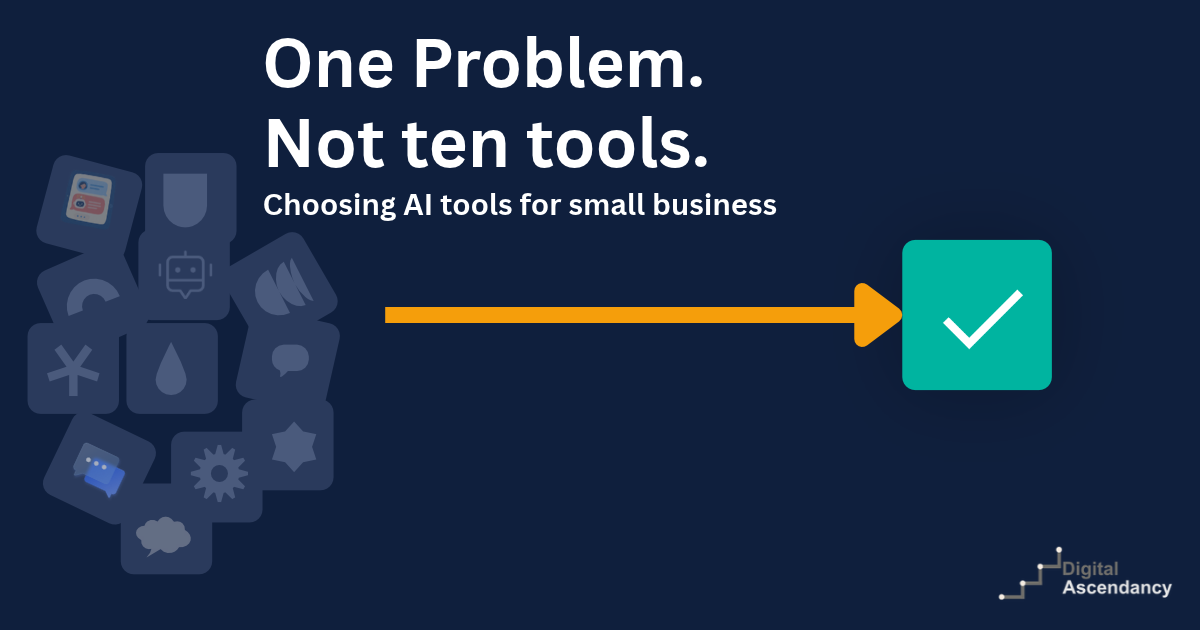
The most useful question is not “which AI tools should I be using?” It is “what is the one thing in my business that is costing me the most time, money or sleep right now?”
Maybe it is enquiries that arrive out of hours and go unanswered. Maybe it is your Sunday evenings disappearing into social media posts. Maybe it is quotes, proposals or emails that take far longer than they should. Start there.
What’s the one problem costing you most?
For many small businesses, it’s enquiries that arrive after hours and never get answered. Our Never Miss an Enquiry chatbot fixes that one problem first.
The four-question filter
Before you sign up for any AI tool, ask yourself these four questions.
- What problem does this solve for me this month? Not someday. Now.
- Do I already have something that does this? Most general AI assistants overlap heavily.
- Will I use it at least once a week? If not, it will not become a habit.
- Can I judge whether its output is any good? If you cannot check it, you cannot trust it.
If the answer to any of these is no, skip it. No guilt required.
A simpler way forward: one problem, one tool, one month
Here is the approach I recommend to the small business owners I work with.
- Pick one problem. The one that hurts most, not the one that sounds most impressive.
- Pick one tool. For most people, a single general AI assistant is the right place to begin.
- Use it properly for a month. Give it context about your business. Refine your instructions. Check every output.
- Write down what works. Keep the prompts and steps that produce good results, so you can repeat them.
- Only then look further. Once you know exactly what is missing, you will recognise the right tool when you see it.
The skills you build this way, such as giving clear instructions, providing context and checking results, work across almost every AI tool. A list of logos teaches you none of that.
How to read the next AI listicle like a sceptic
You do not have to stop reading these posts. Just read them with a few questions in mind.
- Who made it, and why? Is it education, self-promotion or an advert?
- Who is it for? A software developer, a large enterprise or a small business like yours?
- Is “free” really free? Check for trials, previews and paid certificates.
- Are the claims measured? Watch for numbers like “95%” with nothing behind them.
- Does it tell you what to stop using? Good advice usually simplifies. Most lists only add.
Permission to scroll past
The next time a “Top 10 AI tools” graphic appears in your feed, you have permission to scroll straight past it. You are not missing out. You are protecting your time and attention for the one problem that actually matters to your business this month.
AI can be genuinely useful for small businesses. But depth beats breadth every time. One tool, learned properly and pointed at a real problem, will do more for you than ten tools you barely know.
Want help choosing your one problem?
At Digital Ascendancy, we help UK small business owners cut through the AI noise and put practical, jargon-free AI to work where it counts. Whether that is through our implementation-focused Digital Marketing and AI training or a chatbot that makes sure you never miss an enquiry, we start with your problem, not a list of tools.