
Your team started using AI to draft emails. Then quotes. Then someone connected a tool to the inbox to sort enquiries. It all helps, and nobody wants to slow it down. But ask a simple question, “who checks what the AI produces before it reaches a customer?”, and in most small businesses the honest answer is “whoever has time”.
That is not a criticism. It is where most businesses are right now. This guide gives you a simple, written-down AI review process for your small business that takes minutes to set up and does not turn into a second job.
Key takeaways
- Most UK businesses using AI check its work, but very few have a written routine for doing it.
- Your knowledge of your customers, prices and past jobs is what makes a review worth doing.
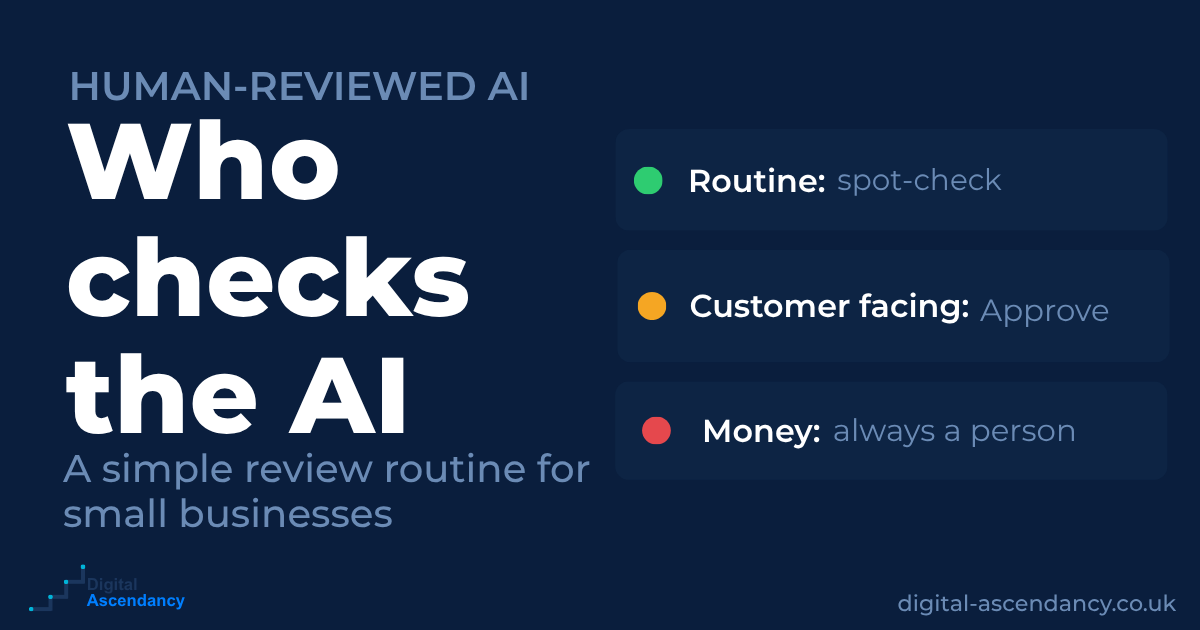
- Sort every AI job into green (spot-check), amber (approve before it goes out) or red (always a person).
- Four light habits keep the routine going: house rules, named reviewers, a simple log and a monthly tool check.
- A well-built AI agent has these checkpoints designed in from day one.
AI is in. The review routine usually isn’t.
Two recent surveys show how quickly things have moved.
The UK government’s AI Adoption Survey 2026, published on 29 October, found that 32% of UK businesses now use at least one AI technology, double the figure a year earlier. Administration is the most common job it is used for, named by 81% of businesses using or planning to use AI. The same report found that 81% apply some human oversight to AI outputs, a slight fall since 2025.
Oversight is not the same as a process, though. In Pax8’s SMB AI Pulse Report for Q3 2026, only 23% of AI-engaged UK small and mid-sized businesses that had built their own AI solution had a formal, documented way of reviewing it. And 24% had found AI tools, workflows or agents running in the last six months that nobody had approved.
So most businesses are checking AI work some of the time, by feel. That works until the day it doesn’t: a wrong price in a quote, a reply that promises something you can’t deliver, or an invoice paid twice.
Your experience is the review
Here is the part that often gets missed. AI is fast at drafting, sorting and summarising. What it does not have is your knowledge of your customers, your prices, your local area and the jobs that went wrong last year.
That knowledge is exactly what a good review uses. A builder who reads an AI-drafted quote spots the missing skip hire in seconds. A practice manager knows which patient message needs a softer tone. The AI multiplies your output; your experience keeps it right. A review routine simply makes sure that experience is applied in the right places, rather than everywhere or nowhere.
The traffic-light routine
You do not need a policy document. You need one sorting rule. List the jobs AI does in your business, then give each one a colour.
Green: routine and low risk
Internal summaries, tidying notes, sorting emails into folders, first drafts nobody outside sees. Let the AI get on with it and spot-check a handful once a week.
Amber: anything a customer sees
Replies to enquiries, social posts, appointment reminders, quotes. A person approves these before they go out, at least until the tool has earned your trust. After a month of clean results you might move to checking a sample each day.
Red: money, legal, or anything hard to undo
Payments, refunds, contract wording, deleting records, anything involving personal data you would not want shared. A person always approves, every time, however good the AI has been.
Most businesses find that the bulk of their AI jobs are green or amber. That is good news: it means the red list is short, and the people approving it know exactly what they are responsible for.
Four habits that keep it light
A routine only works if it is easy to keep up. These four habits take very little time.
- Write down your house rules on one page. Your tone of voice, what the AI must never do (quote prices, promise dates, give legal or medical advice) and when it must hand over to a person. Paste it into the tools you use.
- Name a reviewer for each amber and red job. One person, not “the team”. If they are away, the job waits or the backup steps in.
- Keep a simple log. A shared sheet with the date, the job, who approved it and what they changed is enough. The changes tell you where the AI needs better instructions.
- Do a monthly tool check. List every AI tool and connection in use, who set it up and what it costs. This is how you catch the tools nobody approved, and the subscriptions nobody uses.
If you are not sure which job to start with, our article You Don’t Need 10 AI Tools. You Need One Problem Worth Solving. walks through choosing one.
How AI agents build the checkpoint in
The review routine matters even more once you move from chatbots to AI agents. A chatbot answers questions. An agent completes tasks: it books the appointment, updates the record, chases the follow-up. (If that distinction is new, see Chatbot or AI Agent? What UK Small Businesses Actually Need in 2026.)
Because agents act, a well-built agent has the traffic lights designed in from day one. Green tasks run on their own. Amber tasks are prepared and queued for a quick yes or no. Red tasks always stop and wait for a person, with everything they need to decide in one place. As the agent proves itself, you can choose to move a task from amber to green. Never before.
That is how we build every agent at Digital Ascendancy, from the Customer Service Agent to the Invoice Processing Agent, which checks supplier invoices and flags anything odd but never makes a payment. The agent does the work. A person approves what matters. See the AI agents we build, or read our guide DIY AI Agent or Custom-Built? if you are weighing up building one yourself.
What this means for your business
- If your team uses AI at all, spend 20 minutes this week listing the jobs it does and giving each a colour.
- Make sure every amber and red job has a named reviewer and a one-page set of house rules.
- Check monthly for tools nobody approved and bills nobody expected.
- When you are ready for an agent, ask where the approval steps sit before you ask what it costs.
Want a second opinion?
If you would like help sorting your AI jobs into green, amber and red, or working out where an agent could take work off your plate safely, book a free 20-minute call. No jargon and no hard sell.
Sources: AI Adoption Survey 2026, executive summary (Department for Business, Innovation, Science and Trade, 29 October 2026); Pax8 SMB AI Pulse Report Q3 2026, reported by Compare the Cloud (13 October 2026, 350 UK respondents).
Anura Tennekoon
Director & Lead Consultant, Agentic AI & Automation, Digital Ascendancy. Anura helps UK small businesses put reliable, human-reviewed AI agents and automation to work. His background is in software engineering and digital marketing, and he has delivered professional qualifications, apprenticeships and government-funded digital skills programmes.